Patrick Vieira Opens Up on Coaching Philosophy and Football Obsession
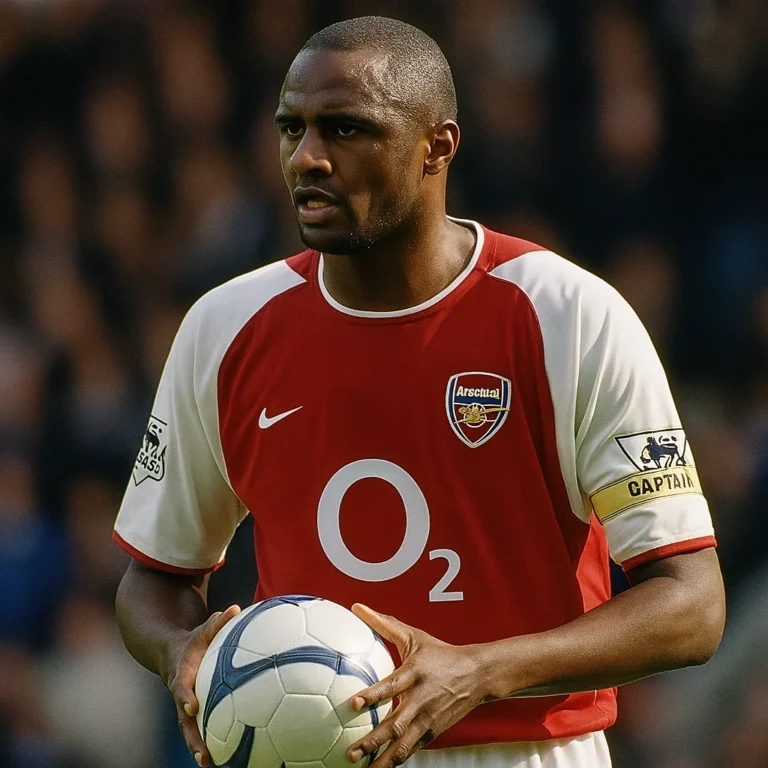
In a wide-ranging and revealing interview, former Arsenal and France midfielder Patrick Vieira has offered a rare and candid insight into the philosophy that has defined his transition from a decorated playing career to a life in the dugout. The 47-year-old, who has managed OGC Nice, Crystal Palace, and Strasbourg, spoke at length about the passion and principles that have guided his journey through football.
Vieira, who enjoyed a storied playing career with Arsenal, Inter Milan, and Juventus, winning the World Cup and European Championship with France, described football as his "oxygen." He revealed a lifelong obsession with the game, tracing it back to his youth. "I started keeping notebooks of training sessions when I was 18," Vieira explained, referencing journals he began in 1995 that he still consults. "I noted down every session I experienced, thinking it might be useful one day. And it has been."
His path to management was not a foregone conclusion. A serious injury sustained in a plane door accident in 2004, while he was a player at Rodez, forced an early end to his playing days. "I had no choice but to become a coach if I wanted to stay in professional football," Vieira stated. His coaching journey began at the very bottom, managing in the French regional leagues, where he performed tasks far beyond tactics. "In the lower divisions, I did everything—I made the sandwiches, I drove the minibus, I filled it with fuel," he recounted. "I managed everything from salaries to travel."
For Vieira, the core of his management philosophy is a relentless focus on the collective. "I told the players: it's not about Patrick, Pierre, or Jacques. Only the club matters," he said, describing his first press conference at his clubs. He demands a high work ethic and a team-first mentality, a principle he enforces strictly. He recalled substituting a young player, Isaac Cossier, after just 33 minutes in a match. "I took him off because he wasn't in the game. I told him, 'I have nothing against you, but for the good of the team, I had to take you off.' The next week, he came on as a substitute and scored the winner."
His approach to recruitment and development is defined by a search for intelligence over physicality. He actively seeks players who may not fit the traditional physical mold but possess the footballing intelligence to adapt. "For me, intelligence is the number one quality of a footballer," Vieira asserted. He cited the example of Gabin Bernardeau, a youth player who lacked physicality but thrived by developing his game intelligence. "He had to adapt to get a head start on others. That's what helped him succeed."
Vieira's connection to football is all-consuming, even in his private life. His dog is named Messi, following previous pets named Pelé and Cruyff. He spends his rare time off watching more football, from youth games to lower-league matches, analyzing the game he cannot view as a simple fan anymore. "It annoys me because I can no longer watch a match as a fan. I'm always analyzing," he admitted.
Despite the pressures, which he shields his family from, Vieira's door remains open to his players, emphasizing a family-like atmosphere within his clubs. "My players know I can be super demanding, but if one of them has a problem at 5 a.m., they know I'll be there." This blend of relentless demand and unwavering support, forged from a playing career that began in the Paris Saint-Germain academy and a managerial career built from the ground up, defines Patrick Vieira's enduring philosophy of the game.